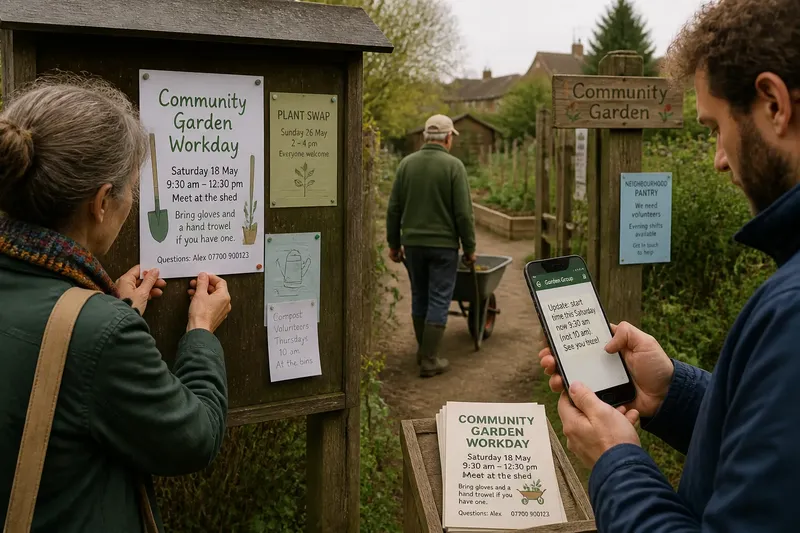
The Volunteer Sign-Up Sheet Is Not a Plan
A volunteer sign-up sheet works better when each task has a clear scope, owner, and next step, helping neighbors choose work they understand and can accept.
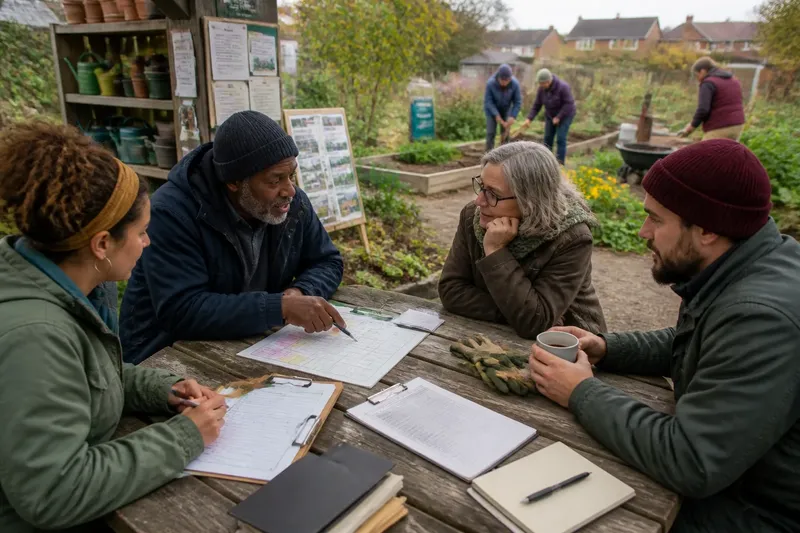
A volunteer sign-up sheet can collect names before a community garden has decided who will open the gate or where supplies will go. A volunteer sign-up sheet becomes useful when each task has a clear scope, an owner, and a next step that lets a neighbor decide what they are agreeing to do.
The right format depends on the project’s stage. An early idea needs interested neighbors and shared planning; a settled workday needs defined jobs; recurring work needs a handoff. Treating all three as the same kind of sign-up makes the sheet look more certain than the work really is.
Use an interest list while the work is still taking shape
If the group has not settled the project or its tasks, ask about interests, skills, and availability without implying that anyone has accepted a job. A line beside “help with the garden” makes a neighbor guess what the group means, and that guess may not match the organizers’ plan.
A short paper form or shared document could ask whether someone is interested in planting, organizing supplies, or welcoming neighbors, and how they prefer to be contacted. State that the group is gathering ideas and will follow up with specific tasks before asking for a commitment.
An interest list can also show what the planning group has not covered. Several neighbors may offer hand tools, while no one has considered who will coordinate access to water. Record the gap and decide how to address it; do not treat a list of possible helpers as an assignment plan.
Give one-time tasks a clear endpoint
When the work and date are settled, offer bounded tasks that people can accept without taking on the whole project. “Sort and label the donated pots at the community center” tells a neighbor more than “help with supplies.” Include what counts as done, where the work happens, and who can answer questions.
For a shared workday, divide the work by activity rather than putting everyone under one vague heading. A list might include greeting arrivals, setting out reusable gloves, sorting donations by condition, and returning borrowed tools. Name a coordinator for each job, even if that person is doing the task too.
Say a group is preparing a courtyard planting day and its sheet has one column marked “volunteers.” The organizer replaces it with three specific jobs: label seed trays, greet residents at the entrance, and collect borrowed tools at the end. The organizer names a contact and a follow-up time for each job. The expected result is that neighbors can choose a defined task and know how to confirm it.
A task description is like a label on a storage jar: it lets someone see what is inside without opening every container. Keep it concise, but include details that affect the decision, such as the time, location, materials to bring, or whether the work is outdoors or involves lifting.
Name an owner and handoff for recurring work
Some neighborhood projects continue between gatherings. A lending shelf may need someone to check requests; a garden may need a way to pass along watering information and supply needs. One-time sign-ups do not answer who keeps that work moving.
Name an owner for each recurring task and make the handoff visible. The owner does not have to do everything. Their role is to keep the next action clear and ensure the next person knows when responsibility changes. A shared document can record the task, current owner, next action, and handoff point.
Keep the commitment bounded. A neighbor might agree to check the lending shelf through a project phase, without taking responsibility indefinitely. Describe the period plainly and ask how the role can pass to someone else. If nobody is ready to own a recurring duty, reduce its scope or postpone it rather than disguising it as a string of casual sign-ups.
Match the sign-up format to the decision
Choose a format that makes the actual decision easy. A polished form cannot make an unclear task clear.
- Early planning: If the project is still being shaped, use an interest form and state that it is not a confirmed assignment; if the group already knows the jobs, use defined task slots instead.
- One-time work: If the job, date, and location are settled, use a paper sheet or shared digital document with a separate line for each bounded task; if details are still changing, have a coordinator confirm them directly.
- Recurring duties: If work continues between gatherings, record an owner, next action, and handoff point; if no one can own the duty, reduce it or defer it.
- Neighbors meeting in person: If people are already together and prefer paper, bring a sheet to the gathering; if several organizers need to see changes, use a shared digital document.
- Tasks involving materials or access: If a neighbor needs supplies, permission, or a key, state who will provide them; if that is undecided, resolve it before treating the sign-up as a commitment.
- An empty task slot: If nobody claims a clearly described job, reconsider its size, timing, or materials; if the task remains necessary, divide it or name a coordinator to discuss it with neighbors.
Paper works well when neighbors are together and prefer not to use an online form. A digital list can help organizers see changes. Either way, the format is secondary to whether the job and the commitment are understandable.
What should a volunteer task description answer?
How specific should a volunteer task be?
State the action and its visible endpoint, such as sorting donated books into labeled boxes for a neighborhood swap. Add the time and place once they are settled, and name a contact for practical questions.
Who should own a volunteer task?
Name one person who will keep the task moving and respond to questions. That person can share the work, but responsibility should not be assigned vaguely to “the group.”
What if nobody signs up for a task?
Read an empty slot as information about the task, not proof that neighbors do not care. Reconsider its size, timing, materials, or clarity; then decide whether to share it, revise it, or defer it.
When does a sign-up become a commitment?
Ask for a firm commitment once the task, timing, and contact are clear enough for a neighbor to judge. Confirm the assignment and next action directly so that a name on a sheet is not mistaken for an agreement.
Turn empty lines into planning decisions
An unclaimed task gives organizers choices: simplify it, divide it, provide missing materials, find a coordinator, or leave it undone for now. Those are clearer responses than leaving a broad request on the sheet and hoping someone interprets it as intended.
Before relying on any volunteer sign-up sheet, check that each listed job has a defined scope, an owner, and a next step. A name can begin a useful conversation; the plan becomes workable when everyone knows what happens after the name is written down.