A Noticeboard, a Group Message or a Printed Flyer?
Choose a noticeboard, group message or printed flyer for a community update by matching its format to how neighbors will encounter and follow it.
A community update works best when its format fits the moment a neighbor is likely to encounter it. A noticeboard, group message or printed flyer can carry the same information, but each makes a different kind of attention easy: a glance while passing, a prompt on a phone, or a page that can be read and kept. Before sharing an update, decide what a reader needs to do and where they are likely to see it.
Decide what the update must help someone do
Start by writing the update’s purpose in one plain sentence. Is it meant to tell people that a shared garden workday has moved, invite them to bring tools, or let them know a neighborhood pantry needs volunteers? That sentence gives you a test for choosing the format. If a neighbor cannot tell what has changed or what to do next, the channel is not the main problem; the message needs work.
Separate the essential information from the background. For an event, the essentials might be the date, time, location, what participants should bring, and a contact for questions. For a change to a shared arrangement, state the old plan only if it helps readers understand the new one. Keep additional context available through a contact person or a longer message, rather than making every version carry every detail.
Then consider the update’s timing. A last-minute change calls for a channel that can reach people who are already following the project. A notice intended to remain useful over several weeks may benefit from a visible, stable place. A printed page can work well when people need something to take home or pass along. These are tendencies, not rules: use what people in your neighborhood actually see and use.
Choose the channel by how readers will meet it
A noticeboard suits information people can notice during an ordinary route: outside a library, at a community center, or near a shared garden gate. Readers usually encounter it without planning to search for it, so a clear headline and a few prominent details matter. The board can also keep an update visible beyond the life of a phone notification. Its weakness is reach: someone who never passes that spot may never see the message.
A group message works when the relevant neighbors already use the same channel and an update benefits from direct delivery. It is easy to send a correction or answer a question in the conversation. It can also vanish among unrelated messages, and people may have muted the group or joined only for a particular purpose. A message is not a reliable substitute for a shared record if details need to remain easy to find later.
A printed flyer gives the reader a portable, self-contained version. Someone can bring it home, put it on a refrigerator, or hand it to a neighbor who does not use the group chat. A flyer takes more effort to distribute and becomes stale if plans change. If an update is likely to be revised, print a clear contact or current-information source so readers can check before acting.
Think of the formats as different places to put the same note: a noticeboard is like a note by the door, a message is like a tap on the shoulder, and a flyer is like a page someone can carry away. None is automatically the most inclusive. The useful question is which encounter is plausible for the people who need the update.
Shape the message for the chosen format
Keep the core facts consistent across versions, but do not force them into identical layouts. A noticeboard needs a heading people can read at a glance, followed by the most important detail and a clear way to learn more. A group message should put the change or request near the beginning, not after a long preamble. A flyer can use a little more space for context, directions, or a short explanation of who is organizing the activity.
Use specific, everyday language. “Bring a hand trowel if you have one” tells a reader more than “come prepared.” Name a recognizable meeting point rather than relying on a vague phrase such as “by the entrance.” Avoid packing a public notice with project history unless the background changes a reader’s decision.
Make the next action explicit. Readers should know whether they can simply arrive, need to reply, should contact an organizer, or ought to check for an update before leaving home. If no reply is needed, say so; otherwise, a group may receive unnecessary confirmations while quieter neighbors wonder whether they are expected to respond.
Use more than one channel when access differs
One channel may be enough when the update concerns a small group that already shares a reliable way to communicate. For a broader neighborhood activity, a second channel can reach people who do not use the first. Pairing a noticeboard with a group message, for instance, can make a change visible both to passersby and to people who follow the organizer’s updates. Use the pairing to extend access, not to create conflicting versions.
Assign one person to maintain the current wording. If the time or location changes, update each active version and remove or mark any outdated notice that readers might still encounter. A simple line such as “Check with the garden team before setting out if plans have changed” can help when printed copies cannot be recalled. Keep it only when that uncertainty is real; extra caveats make settled information harder to read.
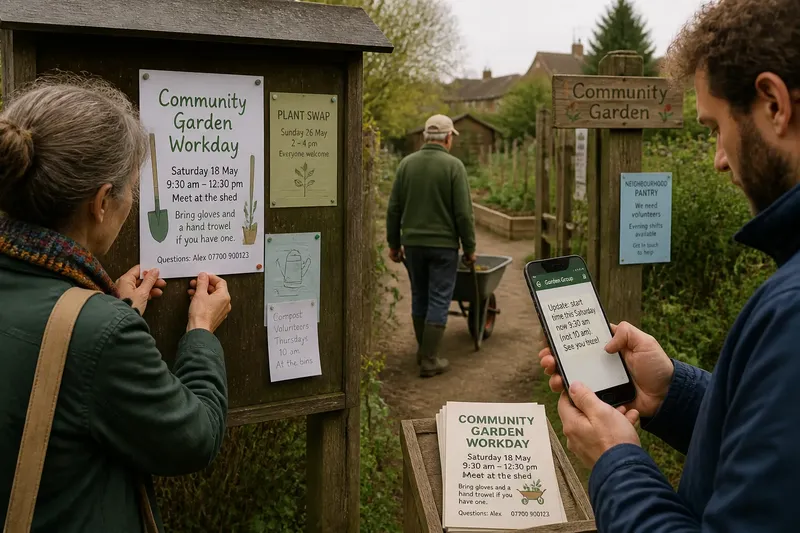
Say you are organizing a shared garden workday, and the community center entrance is where residents commonly pass. You post a short notice there with the date, meeting point, and a contact, then send the same essentials to the existing garden group because the start time has changed. The expected observable result is that a passerby can learn the basic plan from the board while group members see the correction in the channel they already follow. If neighbors who do not use either route need the information, a flyer at another familiar location may be more useful than sending the same message repeatedly.
Check the update before it goes out
- Audience: Who needs this information, and where are they likely to encounter it? Choose a channel that reaches those readers rather than the one organizers find most convenient.
- Urgency: Does someone need to see the update soon, or will it remain useful over time? Favor a direct, active channel for a timely change and a visible, durable placement for an ongoing notice.
- Action: Can a reader tell what to do next? Add the response, arrival, or contact detail that resolves any uncertainty.
- Staying power: Could readers return to the information later? Keep an enduring copy where it can be found, or give the message a clear route to the current details.
- Access: Are some neighbors unlikely to use the selected channel? Add a complementary route only if it reaches them in a place or format they can use.
- Consistency: Do the date, location, and request match across versions? Have one organizer check each active copy after a change.
Which format fits this kind of update?
When is a noticeboard the better choice?
Use a noticeboard when the people you hope to reach regularly pass a known public spot and the information can stay useful there. Make the headline and immediate action easy to find, and provide a contact for details that do not fit on the page.
When should a group message carry the update?
Use a group message for people who already rely on that group and need a timely change or a direct response. Put the newest information up front, and avoid assuming that everyone in the neighborhood belongs to the group.
What makes a printed flyer useful?
A flyer is useful when readers may want to take the details home, share them with someone else, or read them away from a screen. Keep it self-contained, and include a way to confirm the current plan if circumstances might change.
Can the same update appear in all three places?
Yes, if each channel serves a real audience and someone can keep the details aligned. Adapt the layout to each format, preserve the same essential facts, and remove obsolete copies when the plan changes.
Make the channel choice part of the message
Choosing a noticeboard, group message or printed flyer is part of composing a community update, not a final decoration. Match the channel to the way readers encounter information, then make the action and essential details easy to follow in that setting. For a neighborhood update, this small decision can matter more than adding another paragraph: a good message is one a neighbor can actually find, understand, and use.