A Neighbourhood Walk with One Question in Mind
A neighbourhood walk focused on where people pause, meet, and pass through helps residents notice useful gathering places without cataloguing every feature.
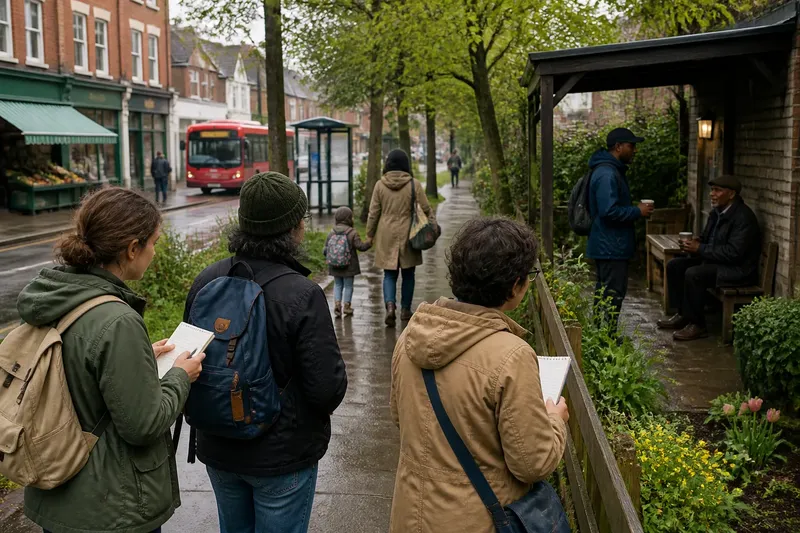
A neighbourhood walk becomes more useful when everyone carries the same question: where do people naturally pause, meet, or pass through? That focus turns an ordinary route into a way to notice how shared places are used, without trying to record every bench, doorway, or patch of grass.
The point is not to catch anyone doing anything. It is to pay attention to the small patterns that shape everyday contact: a corner where neighbors exchange a few words, a path that draws people toward a shop, or a sheltered entrance where someone waits out the rain. These observations can help a local group choose a sensible place for a future gathering or see why an existing spot feels welcoming—or doesn’t.
One question keeps the walk attentive
A broad instruction such as “look around the neighborhood” can produce a list of objects and complaints. One question gives the walk a quieter purpose. Ask where people seem to stop, where they encounter one another, and where movement simply carries them onward.
Those are related but different kinds of places. A pause may be brief and practical: someone checks a phone near a bus stop. A meeting may involve an exchange, however short. A passage is a route people use without lingering. Noticing the distinction helps a group avoid treating every well-used path as a good place to host an activity.
Keep the question open rather than deciding in advance what a “good” gathering place should look like. A wide plaza may be empty at the time of the walk; a narrow stretch beside a community garden may hold several small conversations. The useful observation is what appears to happen, not whether the place matches an ideal.
Choose a route that shows ordinary transitions
Plan a short route through places people already move between: a residential block, a corner store, a library entrance, a bus stop, or a path linking homes to a shared green. Include transitions between these places. The few yards where a sidewalk widens, a fence opens, or a path meets a doorway can reveal more about informal contact than a destination viewed on its own.
Walk at a time that suits the question. A route used by caregivers after school may feel different from the same route on a quiet morning. Seasonal conditions matter too: shade, wind, wet ground, open doors, and changing daylight can alter where people pause. If the group wants to compare seasons, repeat the same route and question, while recording the conditions rather than assuming each walk is directly comparable.
Keep the group small enough to notice without occupying the space. Agree on a meeting point, a comfortable pace, and a plan for anyone who needs to leave early. A phone note or pocket notebook is usually enough for recording themes; detailed photography is rarely needed for this purpose.
Notice behavior without turning people into data
Record places and patterns, not identities. “People waited under the awning while it rained” is more useful and respectful than describing who waited or guessing why. Avoid photographing people or recording private conversations. If someone asks what the group is doing, explain plainly that you are noticing how shared spaces are used and that you are not collecting personal information.
Use neutral language. “The path narrows beside the gate” is an observation; “the path is badly designed” is an interpretation. Keep both if they matter, but label them separately. A simple note can include the location, what was visible, and a question for later: “At the library entrance, several people paused near the notice case; is there room for a small table without blocking access?”
Also notice absence carefully. An empty bench does not prove that nobody wants to sit there. It might be exposed to wind, difficult to reach, or simply quiet at that hour. A walk offers a view of a moment, not a complete account of how a place works.
Seasonal changes reveal different kinds of welcome
In warm weather, people may linger near shade, a drinking fountain, or an open storefront. In colder or wetter conditions, shelter and clear walking surfaces may matter more. Leaf cover can hide a route’s edges; snow or fallen branches can redirect movement. These changes are practical clues about access and comfort, not reasons to rank one season as the “real” neighborhood.
Look for features that change how long someone can comfortably stay: a place to sit, cover from rain, a clear view of approaching traffic, or enough room for a mobility aid to pass. Notice whether a gathering spot depends on a business being open or a gate remaining unlocked. A place can be socially lively yet unsuitable for an organized event if it blocks a doorway or interrupts a route.
Seasonal observation also benefits from patience. If the first walk shows people passing through quickly, the group can return under different conditions before drawing a conclusion. The return visit should answer the same question, not turn into an expanding survey of everything in the area.
Turn a small observation into a useful next question
At the end of the route, compare notes by location rather than by participant. Ask what several people noticed independently, what may have depended on the time or weather, and what remains uncertain. The goal is not consensus about every detail. It is a clearer question that can guide a modest next move.
Say a group notices that neighbors often stop near a community garden gate, but the path there narrows when people gather. They could record the pinch point, return when the garden is open, and ask the garden’s organizers whether a nearby wider area is available for a casual conversation. The expected observable result is a better-informed choice of place, not a claim that the gate itself is a suitable gathering spot.
When a proposed activity affects access, property, or public space, check the relevant local rules and ask the responsible organization before making arrangements. Keep that practical follow-up distinct from the walk: observation can suggest where to ask, but it does not grant permission or settle accessibility questions.
What should a neighbourhood walk look for?
How long should the route be?
Choose a route short enough for the group to walk attentively, with time to pause at a few transitions. A compact loop often produces clearer notes than a long tour that leaves everyone trying to remember too many places.
Should the group speak with people along the way?
Brief, ordinary conversation is fine when it happens naturally, but the walk does not need to become an interview. If someone offers a view, note it as their perspective and avoid treating one comment as the voice of an entire block.
What should participants write down?
Record the location, the visible pattern, and any condition that might explain it, such as shade, rain, a closed gate, or a busy entrance. Separate what was seen from what the group thinks it might mean.
How can the walk stay useful across seasons?
Keep the central question and route broadly consistent, then note differences in weather, light, and access. Compare observations cautiously: a change may reflect the season, the time of day, or an event rather than a lasting shift in neighborhood life.
Leave room for what the walk cannot tell you
A neighborhood walk with one question in mind is a way to notice how shared places invite movement, pauses, and brief contact. It cannot reveal every resident’s needs, explain why a person chose a particular route, or substitute for a conversation with the people most affected by a proposal.
Its value lies in making the next question more precise. Once a group has noticed where people already stop and where they need to keep moving, it can discuss a gathering place with fewer assumptions. Like moving a chair in a crowded room, a small change in position can make an existing space easier to share; the walk helps show where that change might begin.